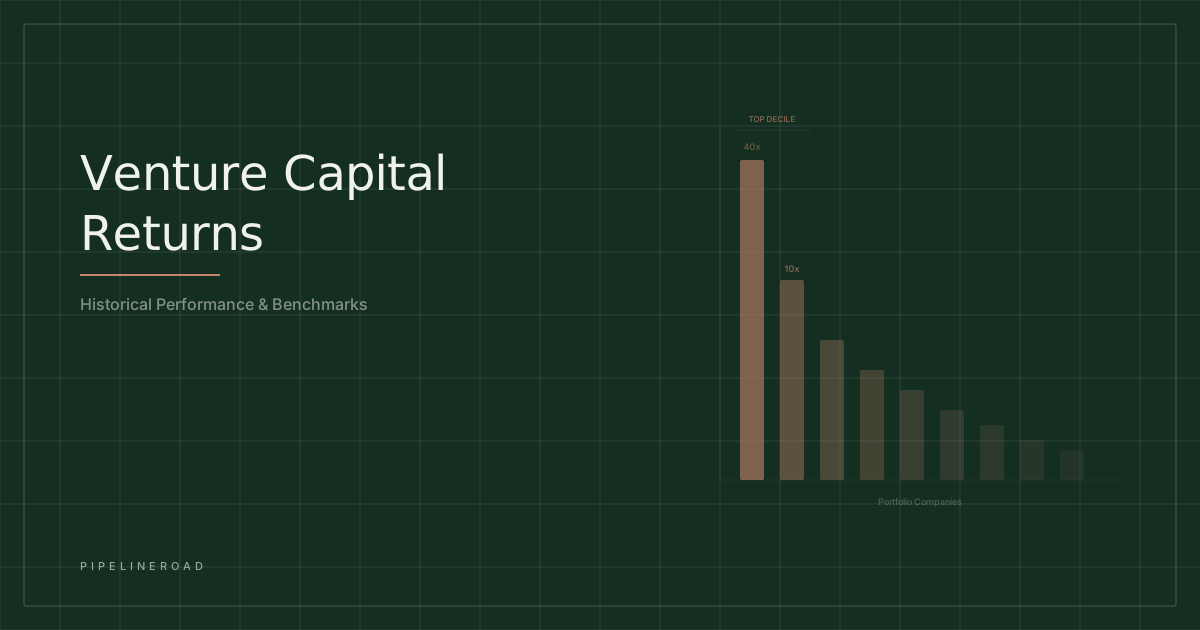
Venture capital returns are unlike any other asset class. The distribution is extreme: a small number of funds generate the vast majority of the asset class’s returns, while a large portion of funds fail to return invested capital. This makes manager selection the single most important decision an LP makes when allocating to VC.
Venture capital returns are defined by extreme dispersion: the gap between top-quartile and bottom-quartile VC funds exceeds 30 percentage points in net IRR, far wider than any other private equity strategy (Source: Cambridge Associates US VC Benchmark, 2024). The 10-year pooled net return for US VC ending 2023 was approximately 14–18% annualized. Use our IRR calculator and fund performance benchmark to model your fund’s positioning.
This analysis covers historical VC return data, how to benchmark fund performance, and what metrics LPs actually use when evaluating managers for re-ups and new allocations.
Historical VC Returns by the Numbers
Cambridge Associates publishes the most widely referenced VC benchmarks. Their US Venture Capital Index, which tracks pooled returns across hundreds of VC funds, shows the following long-term performance:
25-year pooled net return (ending 2023): approximately 12 to 15% annualized, depending on the vintage year weighting. This figure is heavily influenced by the late 1990s vintage years (which include both the dot-com boom and bust) and the strong 2010 to 2015 vintages that benefited from the cloud/mobile cycle.
10-year pooled net return (ending 2023): approximately 14 to 18% annualized, reflecting the strong exit environment for software and technology companies during this period.
5-year pooled net return (ending 2023): lower, approximately 8 to 12% annualized, reflecting the 2022 to 2023 valuation reset that compressed markdowns across the VC portfolio.
These pooled numbers blend all fund sizes, strategies, and vintage years. They mask the enormous dispersion between top and bottom performers.
The Quartile Spread
The gap between top-quartile and bottom-quartile VC funds is wider than in any other private markets asset class. Cambridge Associates data shows:
- Top-quartile US VC funds: 20 to 30%+ net IRR
- Median US VC funds: 10 to 15% net IRR
- Bottom-quartile US VC funds: 0 to negative net IRR
For comparison, the spread in US buyout is much narrower. Top-quartile buyout funds return 18 to 22% net IRR while bottom-quartile buyout funds typically still return 5 to 8%. The wider dispersion in VC reflects the power-law nature of venture returns, where a single investment (a “fund returner”) can determine whether a fund is top-decile or median.
This is why LPs spend disproportionate time on VC manager selection compared to other asset classes. Getting into a top-quartile VC fund produces dramatically different outcomes than investing in a median fund. In PE, the difference matters but is less dramatic.
What Drives VC Returns
VC fund returns are driven by a small number of outsized winners. In a typical VC fund with 20 to 30 portfolio companies:
- 1 to 3 investments generate 50 to 80% of total fund returns
- 5 to 8 investments return 1 to 3x invested capital
- 10 to 15 investments return less than invested capital, with many going to zero
This power-law distribution means that deal access to the best companies matters more than portfolio construction discipline. The best VC funds consistently access high-quality deal flow through founder networks, brand reputation, and platform services that make them the preferred investor choice.
For fund managers raising capital, this has a direct implication: LPs will scrutinize your deal sourcing strategy and competitive advantage in winning allocations in hot rounds. A diversified portfolio of mediocre companies will not produce top-quartile returns regardless of how many investments you make.
Key Return Metrics LPs Use
LPs evaluate VC fund performance using several metrics, each telling a different part of the story:
IRR (Internal Rate of Return). The annualized return accounting for the timing of cash flows. IRR is the most commonly quoted metric but can be manipulated by the timing of capital calls and distributions. Early distributions on small positions can inflate IRR even if the total multiple is modest.
TVPI (Total Value to Paid-In). The ratio of total fund value (distributions plus remaining NAV) to total capital called. A TVPI of 2.0x means the fund has generated $2 for every $1 invested, including unrealized positions. LPs use TVPI as a gross multiple indicator but discount the unrealized component.
DPI (Distributions to Paid-In). The ratio of actual cash distributed to capital called. DPI measures realized, cash-on-cash returns. In the current environment, LPs place increasing weight on DPI because it eliminates the question of whether paper gains will convert to actual distributions. Our DPI calculator helps model this metric.
RVPI (Residual Value to Paid-In). The ratio of remaining NAV to capital called. RVPI represents the unrealized portion of returns. High RVPI in later-vintage funds is expected. High RVPI in older funds (vintage 2016 or earlier) raises questions about whether the GP can convert paper gains to exits.
PME (Public Market Equivalent). Measures what an LP would have earned by investing the same cash flows into a public market index (usually the S&P 500 or Russell 2000). A PME above 1.0 means the VC fund outperformed public markets on a cash-flow-adjusted basis. PME is increasingly used by sophisticated LPs to benchmark private market returns against the opportunity cost of public market alternatives.
Returns by Stage
Different VC strategies target different return profiles:
Pre-seed and seed funds target 3 to 5x net TVPI with 20 to 30%+ net IRR. These funds take the most risk (investing earliest) and need the highest multiples to compensate for the high failure rate. Successful seed funds depend on 1 to 2 companies returning 50 to 100x or more.
Series A and B funds target 2.5 to 3.5x net TVPI with 18 to 25% net IRR. These funds invest at higher valuations but with more de-risked companies that have demonstrated product-market fit. The multiple target is lower but the base rate of success is higher.
Growth-stage funds target 2 to 2.5x net TVPI with 15 to 20% net IRR. These funds invest in proven companies approaching IPO or late-stage exits. The risk is lower but so is the upside, and entry valuations matter significantly. Growth funds are more sensitive to public market conditions because their exit window is shorter.
What This Means for Fund Managers Raising Capital
If you are raising a VC fund, your prospective LPs will benchmark you against these return expectations. Several practical implications:
Track record framing matters. If your fund’s DPI is strong, lead with it. If TVPI is your strongest metric but DPI is still developing, contextualize it with vintage year comparisons and PME analysis. LPs know the J-curve takes time, but they want evidence that paper gains will convert.
Vintage year context is essential. A 15% net IRR from a 2011 vintage is evaluated differently than a 15% IRR from a 2019 vintage. The 2011 fund should have distributed most of its value by now. The 2019 fund is still early. Comparing your performance to the relevant vintage year benchmark from Cambridge Associates or Burgiss is standard practice in LP conversations.
Stage-specific benchmarks. Don’t compare a seed fund to a growth fund. LPs evaluate performance within strategy categories. A 2.5x TVPI on a seed fund is mediocre. A 2.5x on a growth fund is strong. Make sure you know where your strategy fits and what the relevant benchmark is.
Understanding these dynamics is the foundation for productive LP conversations. If you need help identifying which LPs are actively allocating to your strategy and vintage, our LP database covers allocation data across 570,000+ investors.
The Bottom Line
- The gap between top-quartile and bottom-quartile VC funds exceeds 30 percentage points in net IRR: Top-quartile funds return 20-30%+, median funds return 10-15%, and bottom-quartile funds frequently lose capital. Manager selection matters more in VC than any other private markets strategy.
- 1-3 investments generate 50-80% of total fund returns: VC follows a power-law distribution, making deal access to the best companies more important than portfolio construction discipline. LPs will scrutinize your competitive advantage in winning allocations.
- DPI is now the metric LPs prioritize most: After years of paper gains, many institutional LPs set DPI thresholds (e.g., 1.5x+ by year 8) as a key criterion for re-upping. If your TVPI is strong but DPI is developing, contextualize it with vintage year benchmarks and PME analysis.
- 10-year pooled US VC net returns were approximately 14-18% annualized through 2023: The 5-year number dropped to 8-12% due to the 2022-2023 valuation reset. Vintage year context is essential when presenting performance to LPs.
- Stage-specific benchmarks are non-negotiable: A 2.5x TVPI on a seed fund is mediocre, but on a growth fund it is strong. Seed funds target 3-5x net TVPI with 20-30%+ IRR; growth funds target 2-2.5x with 15-20% IRR. Compare against the right category.
Frequently Asked Questions
What is the average return on venture capital?
According to Cambridge Associates, the US Venture Capital Index has delivered pooled net returns of approximately 12-15% annualized over the 25-year period ending 2023. However, averages are misleading in VC because returns follow a power law distribution. Top-quartile funds return 20-30%+ net IRR while bottom-quartile funds frequently lose capital. Manager selection matters more in VC than in any other private markets asset class.
What returns do LPs expect from venture capital?
Most institutional LPs target 15-20% net IRR from their VC allocation, representing a 300-500 basis point premium over public equities to compensate for illiquidity, the J-curve, and manager selection risk. Family offices and endowments with longer time horizons sometimes accept 12-15% from diversified VC programs. The expected return varies by stage: early-stage VC targets higher absolute returns (20%+) than growth-stage VC (15-18%).
How long does it take to see returns from a VC fund?
VC funds typically show negative returns for the first 2-4 years (the J-curve) as management fees and early write-downs outweigh any unrealized gains. Meaningful distributions usually begin in years 5-7 as portfolio companies reach exit events (IPO, M&A). Most VC funds reach their final return profile by year 8-10, though some continue distributing for 12-15 years as tail positions are resolved.
What is DPI and why do LPs care about it?
DPI (Distributions to Paid-In) measures how much cash a fund has actually returned to LPs relative to their invested capital. A DPI of 1.0x means LPs have received back their original investment. LPs increasingly prioritize DPI over IRR or TVPI because it represents real, realized cash returns rather than paper gains. Many institutional LPs now set DPI thresholds (for example, 1.5x or higher by year 8) as a key criterion for re-upping with a manager.